

If there was one moment that the official narrative for a Miami Beach party began to be postponed, it was late at night in May 2011. Then police shot 116 shots at Raymond Herisse, a 22-year-old Boynton resident Beach They said they drove drunk and hit cars. The incident also killed four innocent bystanders who were making national news at the time.
Years later, the Miami Beach Police Department paid $ 200,000 in a settlement to Herisse’s family and innocent bystanders.
But at the time, the takeaway for the city guides wasn’t such that the police acted inappropriately. It was that the party got out of hand.
The incident marked the beginning of increasingly militarized police work in Miami Beach, specifically focused on Memorial Day Weekend – when thousands of mostly black visitors from across the country gathered in the city.
It was also the start of viral videos that city guides say are embarrassing to the city. Street fighting, vandalism and wild behavior. The most recent video to go viral was a group of cars making donuts at an intersection on South Pointe Drive while a crowd of viewers gathered.
“It’s not the kind of thing a city would be proud of. And we’re desperately trying to address that, ”said Ricky Arriola, Miami Beach Commissioner.
Arriola and other city guides are now endorsing a number of new ordinances that they hope will fundamentally rename the city and keep people from partying hard there.
Elected officials have pondered changes for years, but they say a fatal stab in November in the middle of Collins Avenue made the situation in South Beach more urgent than ever.
The package of reforms would mean stricter solid regulations, increased police presence, withdrawing the last call to sell alcohol from 5 a.m. to 2 a.m. and enforcing a new code of conduct for businesses on Ocean Drive.
The legal mechanism is sometimes unclear, but city officials hope the package will drive businesses serving tourists out of the area and ultimately make it more expensive for visitors to stay in Miami Beach.
“If you look at the types of retail stores that are out there, for example, these t-shirt shops, tattoo parlors, occult bookstores, cell phone repair shops, vaping shops that attract a specific clientele, you know, and that is not customers who are a high end tourism market, ”said Arriola. “A certain clientele that comes is drawn to the fact that they can stay in a hotel for $ 80 a night and not have to spend any money when they come, they can just go to the beach. Everything is fine – I’m very egalitarian. People shouldn’t have to be millionaires to get to the beach. ”
He added, “But you have to be able to follow the rules. No public fights, no prostitution, no drug trafficking, I mean – the environment down there is conducive to this type of demographics. ”
Talk of attracting a better “population” can sound a bit like attracting fewer blacks. Black tourism to Miami Beach has increased dramatically over the past 15 years.
“What happens is that people get embarrassed or too nervous to talk about this stuff because they are scared of the race discussion. I’m not afraid of it at all. That shouldn’t have anything to do with race, but the fact that an African American was stabbed to death in the mid 7th and Collins makes you wonder what’s going on here, right? Why should this happen? “Said Arriola. “That doesn’t happen in Coral Gables. It doesn’t happen in Bal Harbor. ”
Javier Vera, who lives on Ocean Drive, says the town and business owners must reach an agreement on how to fight crime without leaving the party scene intact.
Both Coral Gables and Bal Harbor are fundamentally different from Miami Beach. Neither has the same dense mix of bars, nightclubs and hotels. They are far more homely and also don’t attract groups of people who come to South Florida specifically to party.
“If you are trying to reduce the number of black beach goers, if you are trying to lose black business, the NAACP has no problem helping you,” said Dwight Bullard, South Dade executive director of the NAACP. “But we call it a boycott.”
The NAACP led a successful boycott of Miami in 1990, and thus also of Miami Beach. The boycott came when leaders in Miami-Dade County refused to greet Nelson Mandela with honors. This was because Mandela, when released as a political prisoner after 27 years in prison, said that Fidel Castro helped him end the system of racial apartheid government in South Africa – a historical fact.
Bullard said he hoped the city of Miami Beach doesn’t go down that road again.
The NAACP has spoken to Miami Beach for years about treating black tourists on the beach. This last happened last year, before the pandemic ended entirely, when police were caught on a video of black visitors being forcibly detained.
Miami Beach is a global destination city for people who want to party, Bullard said. He called it a virtual “right of passage” for many young blacks – especially in the south – and said that no legislative package could change this fact in the cultural eye.
“When that’s baked into the cake, you can’t suddenly go into that cake and pull out whole eggs. It doesn’t work. It’s baked into the cake now, ”said Bullard.
He said the city should find ways to encourage and interact with visitors rather than creating an antagonistic relationship.
“Praise you, don’t you,” he said. “Because they already say I’m saving my money on Prime 112.”
Keisha Brown, who is Black, and her group of friends, who are also Black, recently came to South Beach to celebrate from Chattanooga, Tenn.
“We only come here to have fun. We’re tired of being in these small towns,” Brown said.
She said it was her second visit to South Beach, and if the city of Miami Beach made the atmosphere less welcoming for groups like hers, she would just go elsewhere.
“I’m just going to Vegas,” she said. “We’ll bring you some money. We’re bringing in some money in Miami. We buy alcohol, buy souvenirs, buy clothes, buy shoes – why should you stop? ”
Javier Vera moved from Chile to South Beach because of the party scene. He’s a DJ and has lived on Ocean Drive for more than a year. He says things get out of hand in South Beach at times.
“I really think the politicians and hotel owners need to sit down and come to an agreement on how things should be done,” he said. “But they have to do it so that the scene stays alive. Because a lot of people like me make our living here in the clubs – and that’s why people come here anyway. ”
Miami Beach residents have already blocked an earlier attempt to tackle the South Beach nightlife. In 2017, the city’s voters turned down a proposal that would have reset alcohol sales on Ocean Drive from 5 a.m. to 2 a.m. The measure failed by a margin of almost 2 to 1.
The proposal was supported by former Mayor Philip Levine and residents, who said they wanted to make the area safer for residents and tourists alike.
In a presentation to the Miami Beach City Commission last month, Miami Beach Police Chief Richard Clements shared data on the reality of crime in the immediate vicinity of Ocean Drive – known as the South Beach Entertainment District. The data showed that more than a quarter of citywide arrests for cannabis possession, battery and resistance to arrest were within the district.
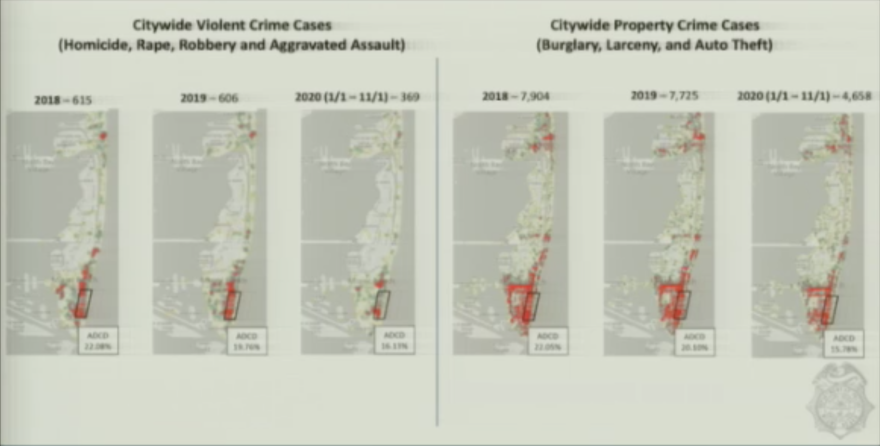
Miami Beach Police Commissioner Richard Clements shared data on urban crime at a commission meeting in December. The image was out of focus in the original presentation.
According to the data, about 1 in 5 city-wide arrests for murder, rape, robbery, car theft and aggravated assault occur in the district each year.
“People often say we can’t stop ourselves. The truth is – we can stop ourselves, ”said Miami Beach Mayor Dan Gelber at the meeting. “But of course that’s not a great thing either.”
In an interview, Mayor Gelber said he knew this country was in the midst of a historic review of police-public relations. And he doesn’t want Miami Beach to be known as a police state.
However, the reality is that police are constantly being called to chaotic scenes with drunk tourists on South Beach, he said. And these kinds of dynamics determine how the city monitors the area.
“You get a call from a restaurant owner or someone [passerby] who sees something. Or 20 people call right away because it’s an open fight and they have to run over there to disarm and de-escalate everything, ”he said. “Every time you do this in a crowd where there has been a lot of drinking and so on, you end up endangering your police, you endanger visitors, you endanger bystanders.”
Gelber said he wanted to let companies and visitors know that the city will rename itself as a “cultural destination” starting with the reform package.
He is sure that the ordinances will soon go through the city commission, although the schedule and some details on how they will prevent hard parties are still in the air.
“If we were in the middle of a desert and there was nothing else around us, like Las Vegas for example, then we might have to say, ‘This is the only way we can attract people here,” he said. “But to scream out loud is this is the most beautiful area in the world with those long, exquisite beaches, parks with beautiful paths and an architecture that is breathtaking and interesting everywhere. ”
“I think people will come here,” he said.
Speaking of reforms that could potentially backfire and damage the economy, Gelber said he was not concerned about it.
“Anyone who says,” I’m not coming because I can’t go wild “- good relief,” said Gelber.
Copyright 2021 WLRN 91.3 FM. To see more, visit WLRN.org.

Comments are closed.